
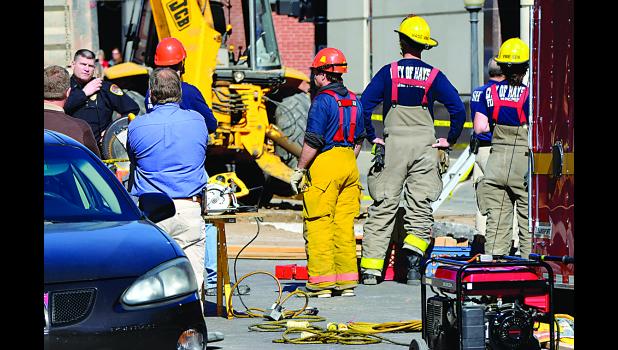
Rescue team responds in dire situations
There’s preparation each firefighter mentally goes through when a call comes in.
That helps them remain calm in the worst of situations and able to offer assistance — no matter the circumstance.
“Every time the pager goes off, we prepare for the worst,” said Capt. Aaron Ditter of Shift C of the Hays Fire Department.
“Every time the pager goes off, you’re expecting the worst until you get there,” said Deputy Fire Chief Ryan Hagans. “Then you see what you truly have. Your mindset is that this is going to be truly bad every time you go out the door.”
While the members of the Hays Fire Department are more widely recognized as the people who battle blazes, their job consists of much more.
All members of the department are part of the Northwest Kansas Regional Rescue team, which is tasked with rescue efforts in building collapses, trench cave-ins, confined spaces and high-angles.
Also included in the team are area volunteer members from rural fire departments in the county.
The regional team got a Homeland Security Grant in 2007 to establish the squad, according to Chief Gary Brown. He said the fire department always had the capabilities to do specialized rescues, but the department decided to develop the skills more.
“We don’t have enough people to staff a team,” Brown said. “What we did is partner with the other fire departments in Ellis County. Ellis County Rural Fire Department, Ellis Fire Department and Victoria Fire Department, we signed an agreement together to staff a rescue team. There are about nine members of the team who are members of other fire departments. … The career staff here trains every month on something to do with tech rescue. Members of the volunteer staff from other companies come in quarterly, spend a Saturday with us and work through the four disciplines — building collapse, trench cave-in, high-angle and confined space.”
The rescue team is highly organized and prepared, according to Brown, but the team is rarely called into action.
“These type of events are low-frequency, but high-consequence,” Brown said. “You have to be prepared for them. It takes a lot of money and effort to be ready for them. But they’re not things you use every day. But when you need them, there’s no substitute for having them.”
The only time the team had been called into action was in 2010, when a portion of the grain elevator in Russell collapsed — killing two people.
But in the early afternoon hours of March 1, the team was called on again.
“When this was called out, you knew it was going to be bad,” said HFD Lt. Luke Scoby. “You could hear it in the dispatcher’s voice,” Brown said.
A trench being worked in by J Corp workers had caved in near Eighth and Main in downtown Hays. Three workers were inside.
“The trench rescue, it’s dangerous,” Brown said. “If the trench is already caved in, there’s the danger of more cave-in that would trap the rescuers. When Capt. Ditter and his crew got there, there were already people working in the trench. There was a bystander — unidentified, we don’t know who he is — who had a shovel and was digging. There was one of the construction workers and two police officers in there digging in the trench. But when there’s a chance for rescue, you take greater risk. While the police officer stayed in the trench, we got the civilian out and construction worker and put some of our people in the trench.”
One worker, Agustin Macias, was able to be rescued and taken to Hays Medical Center. Two others, Aaron Pfannenstiel, 44, and James “Jake” Jacobs, 66, both of Hays, were killed in the collapse.
“The first 10 minutes were treated as we have a victim to rescue,” Scoby said. “We worked until we were told this was not going to happen. Digging or helping EMS, whatever needed to be done, we were going to do.”
When the operation switched from rescue to recovery, the regional rescue team remained — doing the bulk of the work.
“The point with the recovery is that it has to be done so no one else gets injured,” Brown said. “Early on when we were thinking we were going to do a rescue, we stopped all the traffic in two blocks in all directions, shut down the railroad just to make sure there weren’t vibrations to break anything loose. We had to get the heavy equipment out of there — a backhoe running and dump truck half full.”
The firefighters worked hand-in-hand with the Hays Police Department during the recovery process, and five-gallon buckets of dirt were removed one-by-one from HFD personnel.
“The support we got from police was important, just shutting down a part of downtown for us,” Brown said. “When they took charge … that just went hand in glove in the cooperation of the agencies. But we have that cooperation.
“This big event happened, and all these people cooperated because we cooperate every day. The police department, the fire department and EMS are out there every day working calls together. So we know how to work together and support each other. If you don’t do that — if you just wait until the bad event occurs and then say, ‘OK, let’s everybody get together’ — that won’t work. The teamwork, cooperation and people knowing each other and knowing how to work things doesn’t happen unless you just do it every day.”
In a city the size of Hays, the cave-in left a community mourning. Pfannenstiel and Jacobs were longtime residents of the city and had numerous friends and relatives.
“If you didn’t know the victims personally, you knew their family members,” Hagans said. “That’s the way we treat it: This is our community to protect. We’re going to treat them like they’re our family.”
As the situation unfolded, the rescue team’s specialized trailer full of equipment was brought to the scene. Inside are multiple devices and specialized equipment to help with situations from cave-ins to grain storage rescue.
The team began placing boards made as shoring devices in the trench, cutting wood to fit what was needed, placing expanders to fit between shoring and making calls for additional lumber.
The trailer, along with a rescue pumper, works in tandem with the rescue team in such situations. The two make the tech rescue station work, according to Brown.
APAC, a local construction company, offered assistance and brought in a large trench box to aid in the effort. That aided the team in having to build shoring devices to fit the large trench.
“There are emergency calls we go to that are routine,” Brown said. “But you can’t let your guard down on any of it. But this was not routine. If we weren’t prepared to do this, the people involved in the recovery would have been in a lot of danger. So we were prepared to do this.”
The state is organized into eight regions, each with a rescue team. The next closest is more than an hour away.
While the team based in Hays is responsible for the entire northwest Kansas region, a group in Goodland is working to gain similar status. That’s a welcome sight to Brown’s eyes and will aid in the process of rescue situations farther from Hays.
“Our brothers and sisters in Goodland have started a team similar to ours,” Brown said. “They’re getting ramped up to go. If you look at our region, it goes from Russell to Goodland. So they’re looking to take that half of the region. They’re doing it the same way we did it, got grants from the Homeland Security Council and started buying equipment. They’re getting ramped up to do the same thing, and we welcome their activity out there.”
“That’s a long way to the northwest,” Hagans said. “The more help, the better off our region is.”
While the situations the regional rescue team responds to might not happen often, the members must stay ready to answer the call at a moment’s notice.
“We put a lot of effort into it before this,” Ditter said. “A lot of effort and training.”
“This is what we train for,” Hagans said. “When something like this happens, we are ready.”